


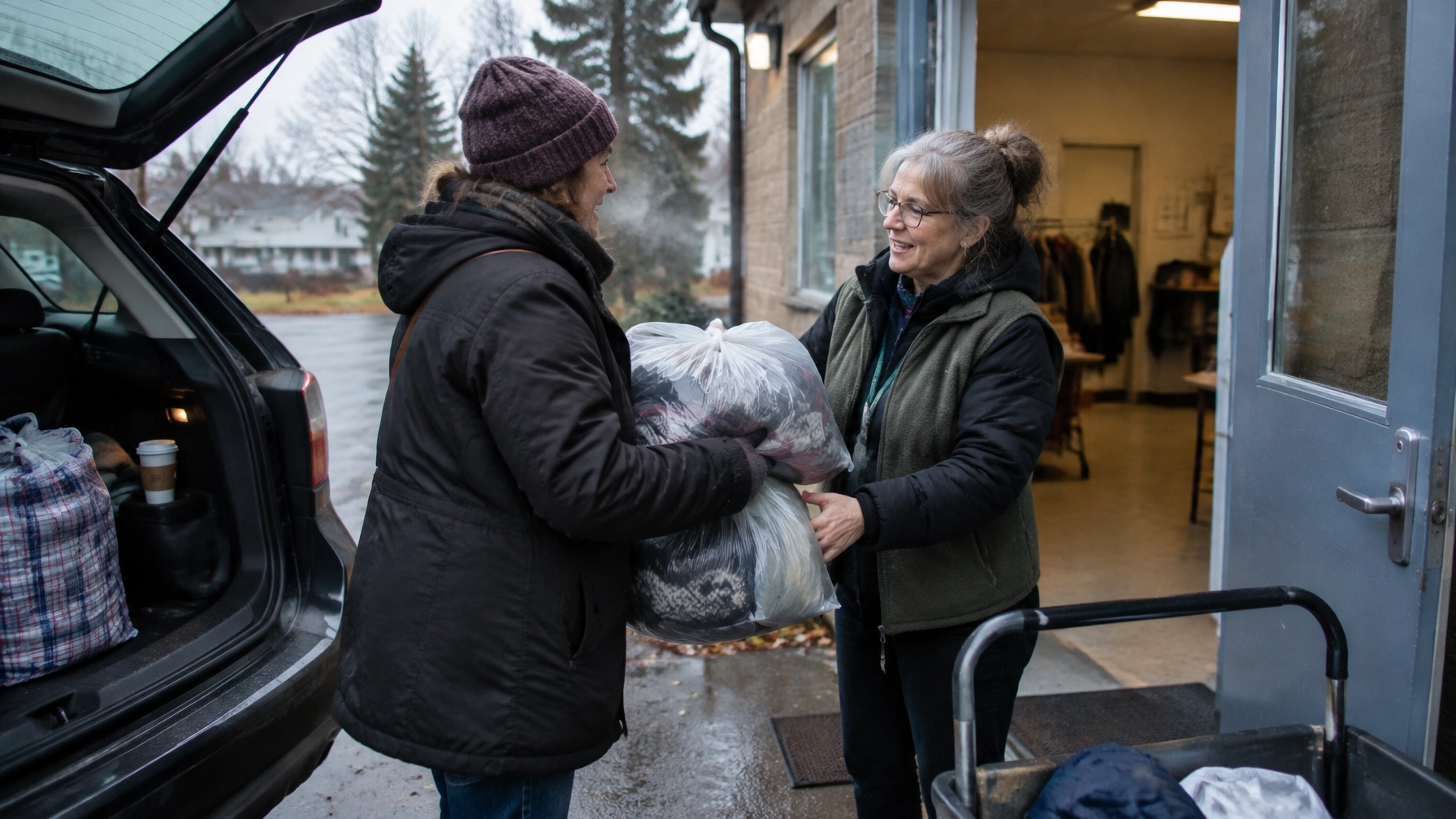
It’s a Saturday morning in late November. You have four garbage bags of winter coats in the trunk and a coffee in the cupholder. You search “where to donate winter coats near me” and find a charity page with an address, no hours, no list of what’s accepted, and one line: “Please contact us for donation inquiries.”
You call. Voicemail.
So you drive to the nearest thrift store instead. That coat drive never happened for your organization. Nobody did anything wrong except leave a page unbuilt.
TL;DR: An in-kind donation page is often the least-designed page on a nonprofit website and one of its highest-intent. Most of the work is answering what you accept and what you cannot. Tax receipt rules are stricter and stranger than many teams assume, especially for services and anything with a “thank-you gift” attached. The good news: you can manage most of this from one CMS collection instead of rebuilding the page every season.
Why this page gets abandoned
The cash donation page gets the campaign, the photo shoot and the donor feedback sessions. The in-kind page gets whatever a coordinator typed in 2019.
But someone searching at 9 a.m. on a Saturday may be the highest-intent visitor your site sees all week. They’ve decided to give. The goods are already in the car. They’re five minutes from being welcomed or turned away.
The job of an in-kind page is not to move someone from a decision to a payment; it’s to prevent a wasted trip, protect staff time and make a useful drop-off possible.
That’s a different job from a cash donation page. A successful visit might mean a donation received, a pickup scheduled with the right details, or someone learning what you need and choosing a cash gift instead of bringing an unusable sofa.
The search questions behind the page
People don’t usually search for “in-kind giving.” They search for the thing they’re holding and the place they want to take it:
- “Where can I donate winter coats near me?”
- “Does [city] have a furniture bank?”
- “Can I get a tax receipt for donated clothes?”
- “Will a charity pick up a couch?”
- “Can I donate opened pet food?”
- “Do charities take used mattresses?”
These are specific, location-based questions with clear intent. Yet many Canadian charity websites answer none of them in readable text. The same goes for AI assistants. Asked “where can I donate a used coat in Ottawa?”, an assistant can only recommend an organization whose website says it accepts coats, where, when and under what conditions.
The page has to contain the answer, not a link to the answer. “Contact us” cannot be quoted. Neither can a PDF about a 2018 donation drive.
If you’re building a broader bank of clear, reusable answers across your site, our guide to building an answer library is a useful companion.
The receipt truth, stated plainly
Receipt questions shouldn’t be buried in a general FAQ. Put the answer where people decide what to donate, and make the policy clear enough that staff can follow it consistently.
What must be on a receipt for a cash gift?
The CRA says an official receipt for a cash gift must include all of the following:
- A statement that it is an official receipt for income tax purposes
- The charity’s name and address as on file with the CRA
- A unique serial number and the CRA-issued registration number
- The city, town or municipality where the receipt was issued
- The date or year the gift was received, and the date the receipt was issued
- The donor’s full name, including middle initial, and address
- The amount of the gift
- The amount and description of any advantage received by the donor
- The eligible amount of the gift
- The signature of someone authorized by the charity to acknowledge gifts
- The name and website address of the CRA
The information must be readable and not easily altered. See the CRA’s official receipt requirements.
What extra information is needed for a non-cash gift?
A receipt for a non-cash gift must also include the date the gift was received, if not already shown, a brief description of the gift, and the appraiser’s name and address if it was appraised. The amount must reflect the gift’s fair market value (FMV) when it was made.
Those fields are a form and a database, not a Word template someone edits every month. The donor’s middle initial is a field people skip. The location where the receipt was issued is separate from the charity’s head office. And the amount and description of any advantage are easy to overlook until someone needs them. Your website or CRM collects information upstream; the form design helps determine what’s available downstream when a receipt is prepared.
Can we issue a receipt for donated services?
No. The CRA says services are not property, so time, skills and effort do not qualify as gifts for official donation receipt purposes. The web designer who donates a site, the photographer at your gala and the plumber who fixes a shelter sink cannot receive a receipt for a gift of service.
The CRA describes one route involving two distinct transactions: the charity pays a service provider for services rendered, and that provider then makes a voluntary donation of money back. The charity keeps the invoice on file. The CRA cautions against issuing a receipt in exchange for an invoice marked “paid.” See its guidance on gifts of services.
You can offer a thank-you letter, but say clearly that it is not an official receipt. Donated time is different from donated goods; if your site also explains how to give time, make that distinction clear on your volunteer page.
How do we determine fair market value?
The CRA defines FMV as normally the highest price property would bring in an open, unrestricted market between a knowledgeable, informed and prudent willing buyer and seller acting independently. If your charity issues a receipt for a non-cash gift, it must reflect FMV. The onus is on the charity to ensure the amount is accurate. If the value cannot be determined, an official receipt cannot be issued.
Generally, someone at the charity or another person with sufficient knowledge of the property may determine an FMV under $1,000. For a value over $1,000, the CRA strongly recommends a professional third-party appraisal from someone not associated with the donor or charity. If appraised, the appraiser’s name and address go on the receipt. A deemed FMV rule may also apply if property was donated within ten years of acquisition or acquired through a tax shelter. Check the CRA’s FMV guidance.
What if the donor receives something in return?
An advantage is something a donor receives in return, such as a meal, tickets, services or sponsorship. If its value is 80% or less of the donation’s FMV, a receipt may be issued for the difference. If the advantage is greater than 80%, no gift is deemed to have been made and a receipt cannot be issued. An advantage of no more than $75 or 10% of the donation’s value, whichever is less, is considered nominal and need not be deducted.
The CRA’s example is useful: a $500 donation comes with two theatre tickets worth $90. Ten percent of $500 is $50, so the $90 advantage is not nominal and must be deducted. It is still below the $400, 80% threshold, so the eligible amount is $410.
That’s why an honour-system “$50 tax receipt” on a gala ticket can be wrong. A ticket’s eligible amount depends on the value of what the donor receives. Ticket price minus the cost of the meal and open bar may be the relevant calculation; if the reception accounts for most of the ticket, there may be no receipt. An auction bidder who receives a $600 vacation rental should not assume the full bid is receiptable.
The same logic reaches further than galas. A branded tote bag handed to a donor at the drop-off door, a raffle prize, a thank-you dinner: anything of value given in return is an advantage. It has to be valued and deducted from the eligible amount, or the receipt is wrong. Most in-kind pages never mention this, so the donor finds out at tax time.
This is general information about CRA receipting rules, not tax or legal advice; your charity’s own advisor should confirm its receipt templates and policies.
The “no” list is your best-performing content
Donors search before they load the car. One of the most useful things your page can do is say what you cannot accept, and why.
- A stained mattress, which you cannot accept for infection-control reasons
- An expired car seat, which you cannot distribute safely
- A CRT television, which you cannot store or pass on
- Opened food, which you cannot accept under your food-handling policy
- A couch that will not fit through the door, which your building cannot receive
A short reason turns rejection into respect. A list without reasons can make a charity look difficult.
Every rejected drop-off takes staff or volunteer time to receive, inspect and store, then may cost money to dispose of. A page that filters out unsuitable donations before someone drives is a page that pays for itself.

What a converting in-kind page actually contains
Make the most important details easy to find, especially on a phone. A useful page includes:
- A clear statement of what you accept right now, with the date it was last checked.
- Current priority needs, phrased as needs rather than broad categories. “Warm waterproof coats, adult sizes, new or gently used” tells a donor more than “clothing.”
- What you cannot accept, with a short reason for each.
- Exact drop-off logistics: address, entrance, hours, stairs, loading dock, parking and whether an appointment is needed.
- Pickup eligibility stated as a rule. For example: “We pick up furniture only for households being resettled, within these postal codes.”
- An honest receipt answer, including what you do not receipt.
- What happens to the item next. Say where the coats go and who they reach. If you have one real photo of the work, use it.
- A way to ask a question, with a stated response time from a human.
The more you answer before a donor sets out, the more likely the item will arrive in a useful way.
Turn the page into a form that screens
Instead of a generic contact form, build a short item-based flow. The visitor chooses an item category and immediately sees whether it is accepted, what condition it needs to be in, where to bring it and whether a receipt is possible for it.
If an item isn’t accepted, offer two alternatives: another organization that takes it, or a cash equivalent such as “$40 covers a new coat.” That turns a dead end into another way to help.

A well-built screening flow can be worth more than a homepage redesign because it changes what arrives at your door.
Switch seasons without rebuilding the page
Coats in November. Toys in December. School supplies in August. Furniture year-round. Hygiene kits after a disaster. Many organizations rebuild or hand-edit the page for each drive, then leave last season’s dates up for weeks.
The fix is content structure, not a new design every season. Each item should be an entry with its own fields, season or status. The page displays what’s live now and hides what isn’t.
A coat drive still advertised in February, or a 2025 date in a 2026 heading, is a small but visible trust-breaker.
Why this page belongs in a CMS, not in a page builder
A collection-based setup, such as a Webflow CMS, can make updates easier to manage without a custom application. It also gives staff a clear place to maintain the rules.
- Keep one collection of accepted items with fields for item name, category, acceptance status, condition, receipt possibility and basis, locations, season or status, and last-reviewed date. One entry can feed the accepted list, “no” list, location details and FAQ.
- Use filtered lists for multiple sites, so the same inventory can show different drop-off details by location instead of relying on four hand-maintained copies.
- Display the last-reviewed date on the page. Donors need to see that the information is current.
- Use reusable priority-needs blocks and a status field to turn seasonal drives on or off without a designer.
- Keep the screening flow simple enough for native forms, and move to an embedded form tool only when you genuinely need branching logic. The cash-equivalent option can connect to whichever donation platform the charity already uses.
- Keep it fast and mobile-friendly. Many visitors are standing in a driveway, using a phone and mobile data.
- For Montreal and Ottawa organizations, support English and French versions from shared item data so the same rules don’t drift apart.
That’s a practical role for charity web design: make the rules easier to maintain and easier to act on. A mission-driven website agency or Webflow developer in Canada should be able to explain how the CMS structure supports your staff’s real workflow, not just how it looks.
Answer engine optimization, applied to donated stuff
Answer engine optimization (AEO) starts with clear, direct answers. Write sentences a person would say out loud. Put the item, city, condition, hours and receipt rule together in the same block. Make the “no” list real text, not an image of a poster. Put the charity’s legal name and CRA registration number next to the receipt answer so an assistant can identify the organization.
Use FAQPage structured data to make question-and-answer content machine-readable, not as a trick that guarantees rich results. Keep a visible last-updated date, too. AI assistants repeat what the clearest pages say; if your page mumbles, an assistant may fill the gap with a generic answer about Value Village.
The confirmation email is part of the page
Right after a drop-off is the one moment a donor is certain they did something good. Most organizations answer it with an automated line saying the form was submitted.
Send a real confirmation instead, and answer three questions in it: what happens to the item next, whether a receipt is coming and on what basis, and what would help right now. For an item you cannot receipt, say so in plain words and point to the honest alternative.
That email is where a coat drop-off becomes a monthly donor, and where an awkward receipt conversation stops being a surprise in February.
It is a different job from the thank-you page after a cash gift. Here the person handed over an object and has no idea what your finance team will do with it. Name the item, name the location, and give them a way to reply to a human.
Measure what the page is meant to do
Don’t judge this page on donation revenue in week one. Watch for:
- Fewer rejected drop-offs
- Staff or volunteer hours returned
- Screening flow completions
- Pickup requests arriving with the right details
- In-kind donors who later become cash donors, tagged as people whose first contact was a coat drive
- Searches such as “donate [item] [city]” where your page starts to appear
The first sign of success may be less wasted work, not more money in the donation box.
Local details make the guidance useful
Montreal
Make the page genuinely bilingual. Machine-translated copy can read as careless to someone who switches languages. Include “dons en nature” in the French content, and make sure both versions state the same rules.
Winter changes the drop-off experience: vestibules, slush, boots and no covered dock can turn a simple visit into a difficult one. Borough geography matters too. A donor in Verdun and one in Rivière-des-Prairies may face very different trips. Say which locations serve which areas, and mention stairs or the lack of a freight entrance, especially in older buildings.
Toronto
In a city with a large thrift retail sector and many agencies close together, specificity matters. “We need these items this week” is more useful than “we accept donations.” Corporate donors offering surplus stock, office furniture or event leftovers need a named contact and a decision timeline, not a general inbox. And one downtown address can exclude much of the city. List satellite locations clearly.
Ottawa
Bilingual content should come from the same item collection, so the English and French rules match. Ottawa’s federal public service culture can mean donors expect precise written policies, especially for pickup eligibility and receipts. Gatineau may be a short drive away, but it is in a different province and has a different language mix. Don’t quietly treat one page as covering both. Make seasonal winter clothing drives easy to switch on in November.
Vancouver
Storage is often the constraint. Donors may be offering furniture they can’t keep, while charities may have nowhere to store it. That makes a clear “no” list and pickup rules especially useful. A short reuse and landfill-diversion explanation can turn decluttering into a values-based choice. Rain gear, sleeping bags and waterproof winter layers may be a standing need, not just a seasonal one. “Greater Vancouver” is not a useful drop-off detail; name Burnaby, Surrey, Richmond or North Vancouver.
Give the page a useful review
If you lead a nonprofit and your in-kind page hasn’t been touched since the last campaign, book a consultation with Arch Impact Studio. We’ll review whether it answers the questions donors arrive with, screens before someone drives, and uses receipt language your finance lead would sign. No hard sell, just a practical look at what the page needs.